 Yearnvaults
 issue shares that represent a claim on pooled assets
Yearnvaults issue vault shares that represent a proportional claim on the underlying assets held by a particular vault. These receipt tokens track a pooled position whose asset value changes with profits, losses, and fees. A share balance measures the holder's units of ownership; the underlying amount available on redemption depends on the vault's accounting and withdrawal conditions.
An unchanged receipt-token balance can accompany a growing underlying asset claim. Reading that position requires separating share units from asset units, then accounting for the way that the vault recognizes earnings and services withdrawals.
In short: A v3 share conversion estimates underlying assets, while withdrawal limits and loss tolerance govern whether a requested redemption can succeed.
The share and its underlying asset
A vault share is a tokenized claim on one vault's underlying balance, while its strategies determine how that balance earns yield. Holding the share gives exposure to the assets and positions that back that specific vault. The receipt token does not create a separate reserve independent of those positions.
The vault's accounting asset
In a v3 vault, the underlying asset is the token that the contract uses for accounting, deposits, and withdrawals. Share units and asset units have different meanings even when their token names look similar. The ERC-4626 asset function identifies that underlying token. A share count alone therefore does not tell the holder how many underlying tokens the position represents.
LP tokens beneath vault shares
An LP-backed vault adds another ownership layer because its underlying asset is a liquidity-provider token representing a pool position. Redeeming vault shares directly returns that vault asset, which can still represent several pool assets. A direct pool withdrawal can convert the LP token into the pool's constituent assets. Some vaults also offer zaps that convert an exit into another asset, subject to the route's quote and slippage tolerance. A vault receipt token and a token inside the pool therefore represent different claims.
Why can a share balance stay unchanged while its value moves?
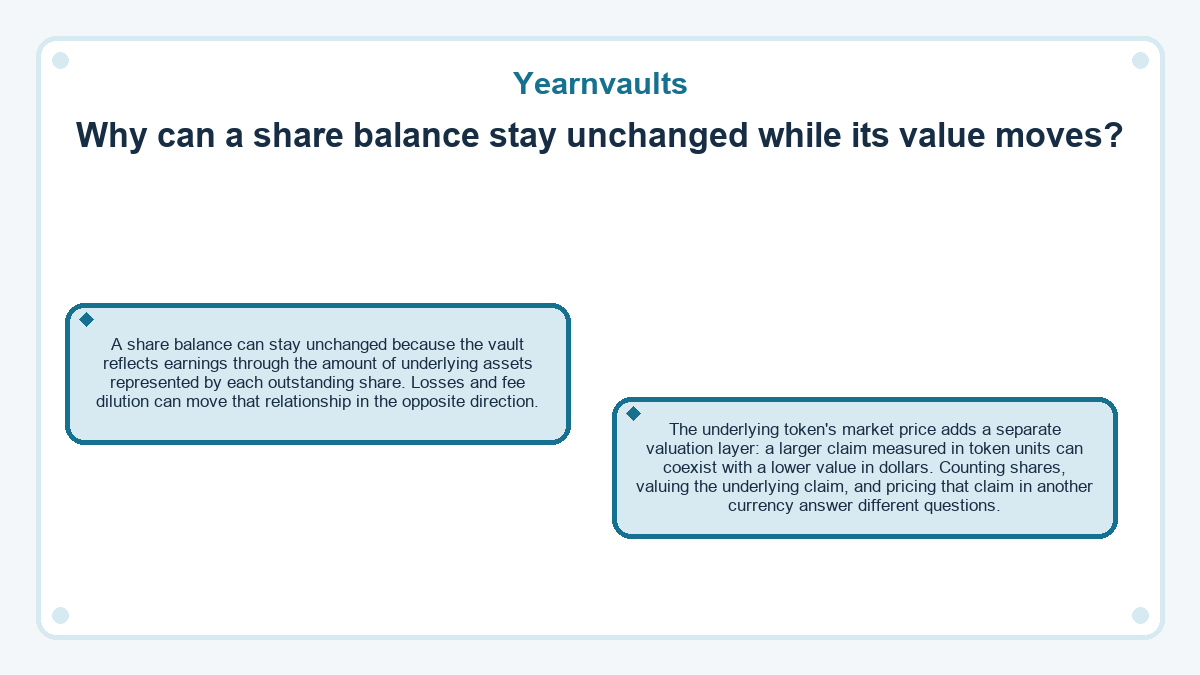
A share balance can stay unchanged because the vault reflects earnings through the amount of underlying assets represented by each outstanding share. Losses and fee dilution can move that relationship in the opposite direction. The underlying token's market price adds a separate valuation layer: a larger claim measured in token units can coexist with a lower value in dollars. Counting shares, valuing the underlying claim, and pricing that claim in another currency answer different questions.
Reports and fees reshape the claim
Reported profits, recognized losses, and fee issuance affect the relationship between vault assets and outstanding shares at different points in the accounting cycle. A strategy can hold earnings that the vault has not yet recognized for depositors.
Reported profit and gradual unlocking
In a v3 allocator vault, a strategy report accounts for gains or losses, applies the relevant fees, and locks profit for distribution. The configured unlocking period controls how quickly reported profits become available to depositors. That period belongs to the particular vault; it is not a universal waiting time for every Yearn product.
V3 Tokenized Strategies have their own reporting and profit-locking logic. Their management or keepers call reports, while an allocator vault accounts for strategy results through its own report process. These responsibilities affect when earnings appear in the depositor's claim. Rewards accumulating inside a strategy and assets already recognized for redemption therefore need different treatment.
Fee shares and dilution
Fee collection can increase the number of shares outstanding without a new deposit from the holder. When a vault mints shares to collect a management fee, existing depositors experience dilution. In the harvest-based management-fee model, the charge uses the time since the previous harvest. Performance fees apply to earned profit, so their percentages and annual management-fee percentages describe different bases.
V3 allocator vaults use a separate Accountant contract when they charge fees. Its configuration can specify performance fees, management fees, or other fee logic. Tokenized Strategies can also charge performance fees through their reporting process. The individual vault or strategy configuration determines which deductions affect its underlying asset claim.
What does ERC-4626 change about a vault share?
ERC-4626 gives v3 shares a common interface for deposits, redemptions, and asset conversions, while each vault retains its own investment exposure and configuration. V2 vaults do not use that interface, so a method designed for v3 cannot automatically describe a v2 position. The standard establishes how contracts express shares and assets; it does not specify the strategy that must generate returns. A common interface makes compatible integrations easier without making different vault shares economically interchangeable.
How do conversion estimates differ from redeemable amounts?
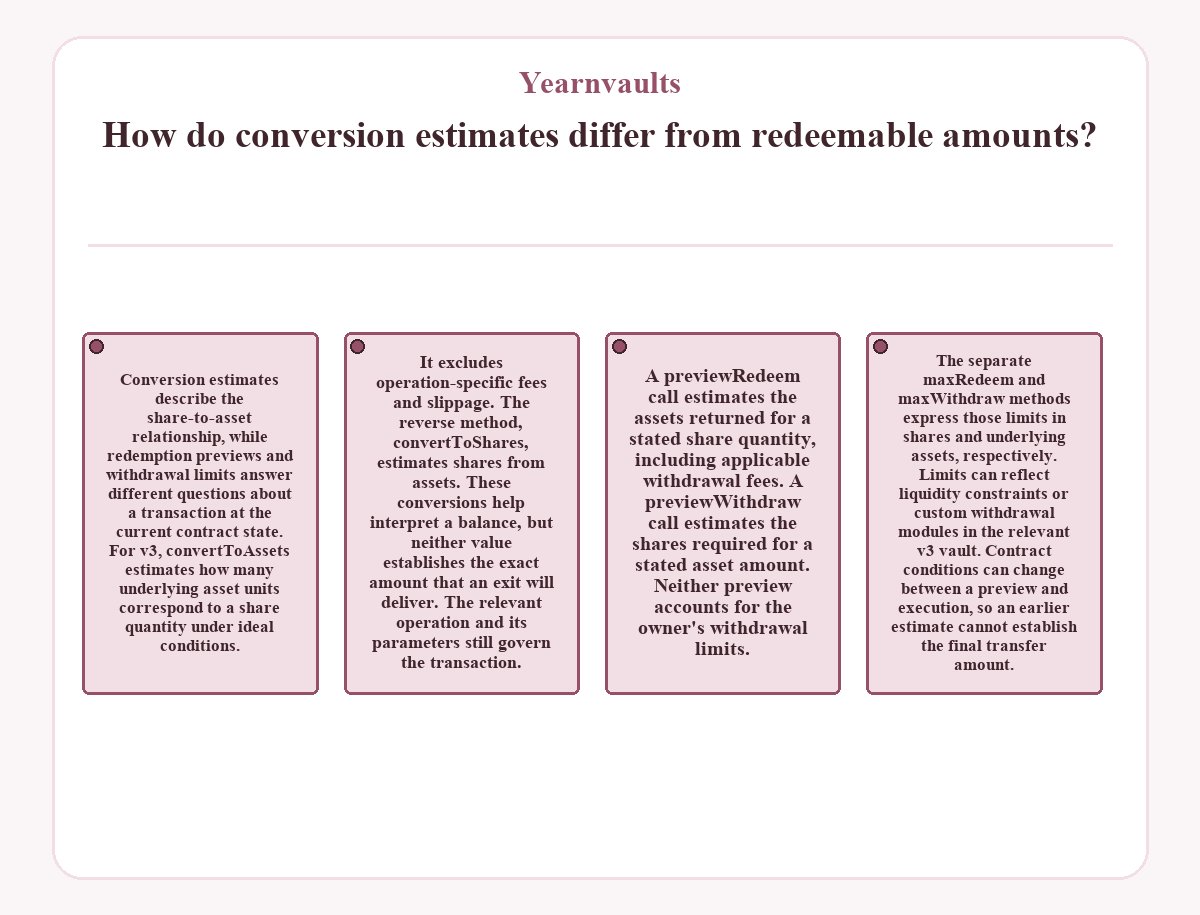
Conversion estimates describe the share-to-asset relationship, while redemption previews and withdrawal limits answer different questions about a transaction at the current contract state. For v3, convertToAssets estimates how many underlying asset units correspond to a share quantity under ideal conditions. It excludes operation-specific fees and slippage. The reverse method, convertToShares, estimates shares from assets. These conversions help interpret a balance, but neither value establishes the exact amount that an exit will deliver. The relevant operation and its parameters still govern the transaction.
A previewRedeem call estimates the assets returned for a stated share quantity, including applicable withdrawal fees. A previewWithdraw call estimates the shares required for a stated asset amount. Neither preview accounts for the owner's withdrawal limits. The separate maxRedeem and maxWithdraw methods express those limits in shares and underlying assets, respectively. Limits can reflect liquidity constraints or custom withdrawal modules in the relevant v3 vault.
Contract conditions can change between a preview and execution, so an earlier estimate cannot establish the final transfer amount.
Fixed asset amounts and fixed share amounts
V3 offers different redemption methods because a holder may want a particular quantity of underlying assets or the redemption of a particular share balance. The selected method determines which units the holder supplies and which amount the contract calculates.
- Choose withdraw when the requested quantity is an amount of underlying assets; previewWithdraw estimates the required shares.
- Choose redeem when the requested quantity is a number of shares; previewRedeem estimates the underlying assets.
- Compare the amount with the matching limit: maxWithdraw uses underlying asset units, and maxRedeem uses share units.
- Set an explicit maxLoss where the v3 withdrawal call supports it, so the chosen tolerance governs losses during the exit.
In Yearn v3 vault calls, maxLoss uses basis points. Omitting this optional parameter gives redeem a default tolerance of 10,000 basis points, or 100%. The corresponding withdraw default is zero, which rejects a withdrawal that realizes any loss. These defaults can make otherwise similar exits behave differently.
Loss tolerance applies to losses realized during the withdrawal; it does not reverse losses already reflected in the share's asset claim.
What readers ask about Yearnvaults
Are Yearn v3 vault shares compatible with ERC-20 balance methods?
V3 vault shares use ERC-20 token balances, so balanceOf reports the owner's share units. ERC-4626 builds on ERC-20 to represent the holder's interest in the vault. Applications must interpret the returned integer using the share token's decimals before displaying a human-readable balance.
Does a category suffix set the value of a vault share?
A category suffix identifies a v3 vault type; it does not set a fixed share-to-asset exchange rate. V3 can have multiple allocator vaults for the same underlying asset. The category forms part of their names and symbols, while each vault's accounting determines the asset claim represented by its shares.
Do share tokens always have the same decimals as their underlying asset?
ERC-4626 recommends matching the underlying token's decimals, but it does not require identical decimal counts. Read the metadata for each token before formatting raw balances. A contract integer needs the correct decimal scale to become a human-readable quantity, and share units remain distinct from underlying asset units.
Can v3 pricePerShare act as an onchain price oracle?
V3 pricePerShare is an offchain helper that integrations should not use for onchain valuation because it loses precision. ERC-4626 conversion functions also require care when another protocol uses them onchain. Their suitability depends on the specific implementation and its susceptibility to manipulation.
Why can related share calculations differ slightly after rounding?
ERC-4626 requires convertToAssets and convertToShares to round down and recommends operation-specific rounding elsewhere. For the shares required to receive a fixed asset amount, it recommends rounding upward. Reversing a previous conversion can therefore produce a slightly different result, even when no fee or market movement explains the difference.
What happens to a share claim when a v3 allocator force-revokes an indebted strategy?
Force-revoking a v3 allocator strategy that still has outstanding debt records a loss and reduces the vault's price per share. Debt here means underlying assets that the vault allocated to the strategy. This forced removal affects the backing of the shares, even if a depositor's receipt-token balance stays unchanged.
Can a v3 caller choose the strategies used to redeem shares?
A v3 multi-strategy withdrawal can use a custom ordered strategy list only when use_default_queue is false. The optional list accepts up to 10 strategy addresses. When management enables use_default_queue, the vault uses its default queue even if the caller supplies another order. This control concerns the source of assets for redemption.